Wednesday, October 31, 2012

The Great Pumpkin miracle

Whoever said that there is no Great Pumpkin is wrong. BUT, Charlie Brown is kind of wrong too.  The Great Pumpkin doesn't give out toys... it saves other pumpkins from being carved on halloween, of course! 


October 29, 2012 - This day will go down as the day the Great Pumpkin waved it's wand, and captured the heart of my 2 year old. Two days before, we went to Butler's Orchard in Maryland to celebrate the last day of the Pumpkin Festival. We had family fun day with their hayrides, giant slides, etc... but the best part was pumpkinland, the pumpkin patch where you can pick the One... or two or three pumpkins that spoke best to you... or your two year old.  

We had a great time and came home with 2 pumpkins - one is a peanut pumpkin to make delicious pie with, and a small-ish pumpkin to carve for halloween.  As you can see, we had great plans for these pumpkins! What's more, with Frankenstorm Sandy threatening to keep us indoors for a few days, carving the 2nd pumpkin and roasting the seeds were going to be the fun activity that was to highlight our cozy time together at home.  My husband and I could picture it, could smell it too: roasted seeds, pumpkin pie, and a simply carved and lit toothed pumpkin smiling back at us. 

Alas, this was not meant to be. All was going well, and my daughter really liked it when my husband drew a face on the pumpkin that we would carve out later.  I could just hear what's going on in her mind - "You can draw on pumpkins?!  Awesome!"  Off she ran to her art table to grab some markers and began to scribble squiggly lines here and there. She had a blast. But the minute that my husband took a knife to the pumpkin, we heard a gut wrenching "Noooooooo!!!!" A few minutes later, we tried a smaller knife, and was still greeted by a fierce cry, howling even stronger than storm Sandy.

Well, friends, our daughter was enamored with her pumpkins.  After that, she began hugging BOTH pumpkins, saying "I love you, pumpkin" and kissing them. Oy vey. The pumpkins live to see another day to tell their story - even a few weeks perhaps, but hopefully not another halloween. Yikes. And that's how the Great Pumpkin save the hearts (and seeds) of 2 mighty pumpkins who captured the love of a two year old. 


A different fairy tale - she's kissing a pumpkin instead of a frog
And instead of a full face, this one gets lots and lots of eyebrows

Tuesday, October 23, 2012

Raising bullies

     Having grown up on the other side of the world, I don't really know much about bullying except for those snippets that I saw on television or read in books.  I'm sure bullying existed in 3rd world countries as well, but for whatever reason - whether the country I grew up in was overly religious, too hungry, comprised of equally poor individuals, or something else - it just didn't seem to be as blatant as here in the US.  I guess because of that, I've always seen this as a problem associated with privilege. 

     I was in San Diego just last week for a business trip, and brought my daughter along for some family bonding time.  One day at the playground, my 2-yr old was happily digging at the sandbox by herself when she got a bit too close in vicinity to 3 older kids in their 3's and 4's. They were annoyed by this, and started shooing her away, saying "Go away!" "We don't want you here!" "You're a baby; We're 4!" Now the kids parents were only 2 feet away, so I at first watched with interest if anyone of them would say anything.  I, on the other hand, was a few yards away, so nobody noticed that I was this toddler's mom. The parents looked over, and continued yakking, and the kids continued with their taunting.  My daughter looked up, smiled, then looked down and started digging again.  Thankfully, she took this digging business quite seriously.  The taunting continued, and then the girls surrounded her.  That's when my mommy antenna went up! Then they started kicking sand at her - all 3 of them. I was horrified with what I saw! And the adults just stood there watching, not caring at all. My daughter looked up wondering what is happening. I ran as fast as I could, and started yelling "YOU! YOU! YOU! Stop that!!" at the girls, pointing individually at them. I was so infuriated, and I asked them why did they kick sand at my daughter?? One of them had the guts to answer me back and said that this was their lot and they didn't want to play with her. I responded with "Well, she doesn't want to play with YOU either! So, what do you say??" The youngest one muttered "Sorry" and all 3 ran off. 

     After that, I waited for the parents to approach me. They knew that I knew that they saw everything and they didn't stop it.  Still, they chose to keep talking to themselves about the weather, and other trivial things.  I could have left after that, but I wanted to give them the opportunity to talk to me.  They could have apologized, they could have tried to explain, or they could have asked me for explanation for raising my voice at their kids. But no. The air was filled with apathy. I waited some more.  Nothing. My husband said that I could have simply taken my daughter out of the situation as soon as I saw the sand kicking. In hindsight, I'm glad that I didn't, and that my fight-or-flee meter ticked the other way.  Someone had to say something to these kids, and I had to hear the "Sorry" even from a 3 yr old. We only got out of the sandbox when the train nearby honked its horn and caught my daughter's fancy. 

     Now I can say that I've learned first hand about bullying, and how ugly it is, and how bullies can be raised by apathy. I'll try my best to make sure that my daughter doesn't turn into one. And if someone tries to bully her again, they can count on Mama bear here to come out growling.


Sunday, October 7, 2012

A world without milk or honey

*This piece was published in Etz Hayim's October Chronicle Issue.

As I write this article, Rosh Hashanah is only a couple of days away. I am looking forward to gathering with friends and family for prayer and festivities. For me, Rosh Hashanah cues the arrival of fall with its sweet, delicious scents. While we cannot be with everyone we love during the holidays, in my mind, we will all share the same tables bearing the staples of round challah, apples, and honey.


Honey has been a part of the Jewish culture since biblical times; the Torah refers to Israel as the "land of milk and honey" to signify its agricultural richness. Unfortunately, over the recent years, there has been a looming fear of honeybees going extinct.  The population of many different species of bees has declined and, with strong correlation, so have the number of wildflowers that depend on them for pollination. Soon to follow, I’m afraid, will be the crops that these bees support such as the alfalfa hay that feeds the cow that produces our milk and meat, as our vegetables and nut crops. In the US alone, the honeybees pollinate $15B worth of crops, including Pennsylvania apples, Florida oranges, and New Jersey blueberries. Agronomists have even gone to say that Americans owe 1 in 3 bites of their food to bees! In a symbiotic relationship in our ecosystem, it is easy to see how the disappearance of bees would translate to famine in a big chunk of the world.


It is generally believed that bees have been around for about 120 million years.  So, bees have done quite well for themselves for millions of years! But over the last two decades, populations of four key bee species have declined by 96% and their geographic ranges have become smaller. Why? How?  Researchers have coined the term Colony Collapse Disorder (CCD) to refer to the disappearance of bees by abandoning their hives en mass. If that name doesn't scare you, I don't know what will. There are no dead bees littering the bottom of a hive; they simply vanish! Thousands of individual worker bees fly off to die. It's almost a traceless mass suicide! But if there is anything we know about bees, it is that they are among the planet’s most loyal creatures; a typical colony would do anything to protect its queen. So, what gives? The cause for CCD has been attributed by some scientists to a virus-fungus combination, and by others to the effect of pesticide. Most likely, there are multiple factors: parasites, fertilizers, pesticides, climate change, urbanization and even economic causes such as professional beekeepers closing shops.

The weird weather we've been having certainly has a major impact on these foragers.  The summer has been too wet or too hot. There are not enough blooming flowers during the growing season. And the expanding urban landscape does not provide the hive with enough honey to survive the winter.  Adding insult to injury, natural disasters affect the bee population too. For instance, a series of hurricanes in 2004 decimated the Gulf Coast bee industry. When bees are at their weakest, parasites are at their strongest, attacking the bees’ immune system. Mites transmit viruses from bee to bee and between adult and larvae. So if the mites do not kill the bees, the viruses surely do. If the bee survives the virus, a fungal gut parasite delivers the final blow. And with pesticides, the bottom line is that the bees get disoriented and unable to locate their hives - a sure death sentence for these hardworking insects.  


But, there is hope. The 2008 Farm bill approved USDA grant programs to include pollinators such as bees to become research priorities. Outside of farms, homeowners and policy-makers alike are being educated and encouraged to incorporate floral diversity in urban landscapes and roadsides. 


Why do I write about this now? In this season of football and politics, where tensions are running high, there are still some issues that touch the memories of our childhood.  For me, Rosh Hashanah brought just that.  I cannot enjoy honey without thinking of my encounters with bees when I was a child. I remember how one day I collided with a bee while running full-speed. It bounced off my cheek, and I spent an entire hour brushing an imaginary sting away. But now that I'm an adult, there just don’t seem to be a lot of bees around. I hope that writing about the plight of bees will strike a common chord in our community. Whether you live in a house with a nice backyard or can only plant in flower boxes, it is possible to mitigate the plight of bees, restore some balance and harmony in our ecology, and ensure far sweeter future years to come. Here’s to hoping for a buzz-worthy year ahead! L’shanah tovah!

Tuesday, September 11, 2012

Berlin diary - Parting thoughts and travel tips

On the 6th day of my trip, I did nothing but pack, ate breakfast and flew home.  During flight, I thought about things that worked and didn't work, and general observations from this trip.  For one, I overpacked yet again - but this time on books, not on clothes.  I intended to read 2 thick books on the history and culture of Germany in addition to a non-fiction book I brought with me. But really! Who would want to read books when you could live history, plus create your own, outside the hotel doorsteps?!

What else? Let's see:

  1. Skip the workout clothes. I packed workout clothes but didn't get to use them as I was either at the conference or was too exhausted after exploring the city on foot. 
  2. It was smart to bring my own adapter and converter.  European countries use 220 volts, so you need to use voltage converters for appliances and gadgets from the US that generally use 110 volts.  In addition, they use sockets that only have the circular prongs, so you'll need an adapter.  While I was told that the hotel may provide these, I didn't take my chances. That was a good thing because the hotel was fully booked with conference participants, and they ran out of these supplies!
  3. No show TV shows. All shows, except for CNN and BBC, were in German. Even American series were dubbed with German! It's a good thing I don't like watching television anyway, so I just read my book.  But if you're one who likes to watch the telly, make sure to bring your own DVDs.
  4. It's expensive to surf... the net, that is. The hotel only had free internet at the lobby. In your room, you have to pay 24 Euros per day to connect, regardless of whether you're a conference participant or not. 
  5. The tube rocks. If you're familiar with the DC metro, or the NY subway, you'll be able to navigate the S-Bahn and U-Bahn no problem. The Berlin railway system may be bigger, but it works exactly in the same way where you just need to know the end of the lines to determine which direction you should be heading. 
  6. Money talks, credit cards not so much.  It's amazing how spoiled we are here in the US.  In Berlin, the cabs don't take credit cards. Even some moderate-sized establishments and restaurants don't take credit cards! And be aware that in small stores tucked away from tourists, they either don't have receipts or don't know what you mean by "receipts"
  7. Airport comments:  Tegel in Berlin is tiny and very manageable. Frankfurt airport is chaotic.  The signs are not clear, and there are constructions at different points, so you're not sure where you should go.  The gate for my flight didn't show up on the screen until about 1 h before boarding cause there wasn't enough room to post the information.  In the meantime, I was left to loiter around amidst confused people. My gate changed 3 times; they announced the gate change first in deutsch, then in english.  That means that while everyone have left to run to the new gate, I was still waiting for the information! Thankfully quite the opposite, the airport in Brussels, Belgium is big and organized.  The signs and arrows appear in bright yellow.  The security is tight, but it moved quickly. Still, you probably need more than 1 hr to navigate this airport and security, simply due to its size. So... bottom line: I'm happy I didn't have just an hour of layover and that I checked my bag. It certainly made for a more efficient transfer.
  8. "Thank you" will bring you a long way. I tried to arm myself with a couple of German phrases before I left, but believe me, once your conversation partner start rattling off in Deutsch, you're left pretty much slack-jawed and unable to respond. So all I could utter was Dankeschön (pronounced Dunk-uh sheon) for the most part. I think that the effort was very much appreciated, judging from the smiles I got. It never hurts to be polite.
And that's a wrap.  After tapping my heels together, I am finally home and hugging my giggly toddler. As fun as this adventure was, truly, there's no place like home, Toto.


Friday, September 7, 2012

Day 5 - Berlin diary - Of history and jelly donut

My last full day in Berlin. For half this day, I wore my scientist hat, then went full-on tourist for the afternoon, but minus the belt bag. So, what do you get when you stuff a tourist bus with the brightest minds in science? You'd probably expect Ooohs and Aaaahs as they get a glimpse of history, or perhaps blank stares and silence... but then you'd be wrong.  I heard whisperings of "proton exchange", "simulation", "binding pocket" and "sodium channel" floating in the air. I couldn't help but chuckle at the notion that potential research collaborations were being built right there and then! Oh, how I pity our bus driver.

The Wall and East Berlin tour focused on the history after WWII.  We headed from the hotel to Kreuzberg where the grand brick Oberbaumbruecke bridge separated what used to be West and East Berlin.  We stopped at the most famous remains of the Berlin wall, also known as the "iron curtain", which divided the east from the west to prevent the eastern berliners from migrating to the west and draining the east side of its people resources. 

Oberbaumbruecke bridge
Double brick designates where the wall used to be. 
The white crosses memorialize those who were killed trying to cross it.


To give you a bit of a background, after WWII in Europe, Germany was divided into 4 zones that were controlled by US, UK and France (West) and Soviet Union (East), and the East berliners fled in droves with the growing fear of sovietization of the east. The 160 km wall was built in 1961 and stood as divider until its fall in 1989. After the fall, artists the world over were invited to show their interpretation of this freedom and unity by painting murals on the wall in what is now called the East Side Gallery. 


Berlin wall - "The Kiss" between Soviet leader Leonid Brezhnev and East German President Erich Honnecker (based on a true photo)


We continued along our tour, and I noticed the prominent different colored pipes running above ground.  I asked the guide about this,  and she said that it was due to the high water table in Berlin.  These pipes helped drain the water at construction site.  At least, they were painted in colorful hues! I also noted how the yellow traffic light turns on with the red light just before the green goes on; it's like a cue for drivers to rev their engines!

 
Bright pink water pipes

We passed Berlin's TV tower, which reminded me of Paris' Eiffel tower, and remains the tallest structure in Germany.  It also had a rotating restaurant located at the round silver top. The tour then passed museum island buzzing with toursists and university students alike as the island houses many fine building from 18th and 19th century and the Humboldt University.  I was disappointed that we weren't let out of the bus at the this time.  I definitely have to file this under places to explore for a future visit, should there be a next time. And I think that next time, this area would be even much improved with all the constructions and reconstructions going on right now, and additional stations being built. One museum will sit where the royal palace used to stand before it got blown up.


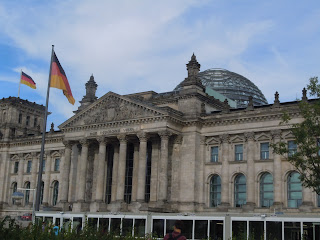
The next stop was at the Reichstag and Brandenburg gate. The Reichstag building housed the German parliament. It has a glass dome on top which boasts of an amazing view of the city, but you have to fall in a mile-long line to reserve a spot! Apparently, you can reserve in advance on the net, but I didn't know that. The Brandenburg gate is the world-reknowned landmark in Berlin, and is the only remaining historical gates leading to the city.


Brandenburg gate


Reichstag building

Last stop was at Checkpoint Charlie, the name derives from the Phonetic alpabet, and this was the 3rd checkpoint in the city. Well... ehhhh.... it just feels like a tourist trap area now, and the guide warned us to watch out for pickpockets. Then we headed back to the hotel to prepare for the gala dinner that will signal the end of the conference. While there are always pros and cons in joining tours - it can be highly informative, but you can miss out on exploring the ones that matter most to you - I'd say that given the short time I had, this tour was a good idea.
 
Since I was all dolled-up, I decided to take a cab instead of the tube.  The sit-down dinner was lovely, but what was nicer was to see my colleagues finally unwinding! I sat in the middle of a Finnish and a British scientist, and got to hear about the state of research and pharma in Europe, the difficulty of finding jobs and also a little bit about politics.  It made me realize how foreign yet similar our concerns are. 

Tomorrow, I'm leaving Berlin, but tonight I'll enjoy the music and pretend that Ich bin ein Berliner! - I am a Berliner... but not the jelly doughnut kind.