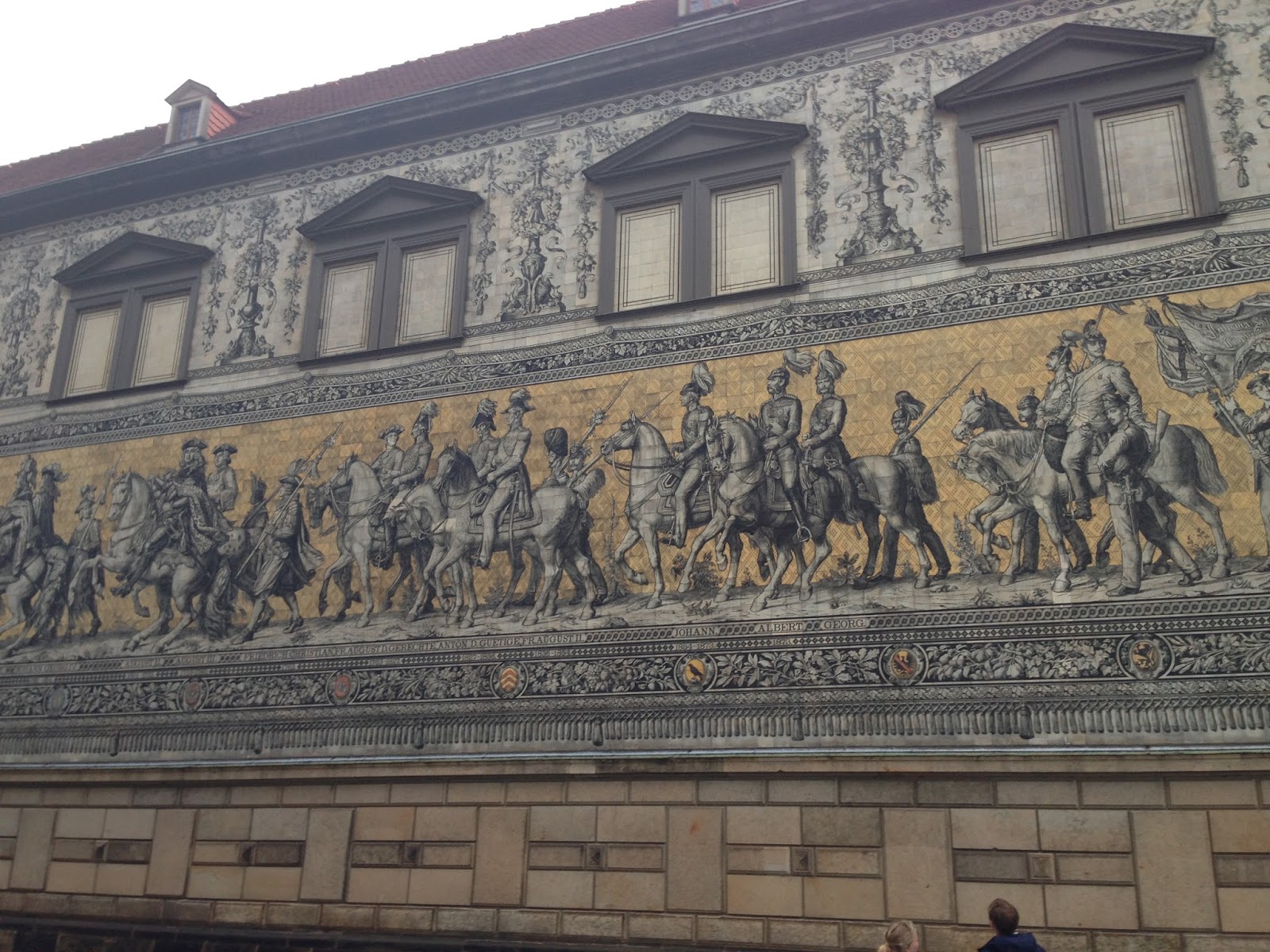
My day of exploration didn’t start until late afternoon at
the end of a busy day listening, talking, thinking and seemingly drinking in
science. It’s a good thing my curiosity
always wins over brain strain. On the agenda was the Zwinger
(pronounced Zvi-nger) museum, which is a convenient 5-8 minute walk from the
congress site. The Zwinger is a palace that was turned into a 3-in-1 museum
complex, housing the Gemäldegalerie Alte Meister (Old
Masters Picture Gallery), the Dresden
Porcelain Collection (Porzellansammlung)
and the Mathematisch-Physikalischer Salon
(Royal Cabinet of Mathematical and Physical Instruments). Hard as it was, I had to decide which among
the 3 museums I was going to, given the time limitation; all 3 closed at 6 pm and
it was already 4:30 pm. I eventually decided on
the math and physics collection. The force was strong on
this one.
My day of exploration didn’t start until late afternoon at
the end of a busy day listening, talking, thinking and seemingly drinking in
science. It’s a good thing my curiosity
always wins over brain strain. On the agenda was the Zwinger
(pronounced Zvi-nger) museum, which is a convenient 5-8 minute walk from the
congress site. The Zwinger is a palace that was turned into a 3-in-1 museum
complex, housing the Gemäldegalerie Alte Meister (Old
Masters Picture Gallery), the Dresden
Porcelain Collection (Porzellansammlung)
and the Mathematisch-Physikalischer Salon
(Royal Cabinet of Mathematical and Physical Instruments). Hard as it was, I had to decide which among
the 3 museums I was going to, given the time limitation; all 3 closed at 6 pm and
it was already 4:30 pm. I eventually decided on
the math and physics collection. The force was strong on
this one. The salon boasted of clocks, lenses, globes, measurement instruments and other related instrumentations. The museum highlights innovative technologies in precise timekeeping and calculation during 1550-1900.Hey, German precision, right? The top 3 items that stood out to me were the:
- 5-minute clock that tells time in 5 minute increments instead of by the minute,
 |
| 5 minute clock |
- the world clock (1690) that tracks 24 hour time zones in 1 face, showing the time in all latitudes on 360 individual dials,
- a celestial globe, perhaps the oldest exhibit on display, dating from the 13th century. I have actually never thought that stars and constellations can be represented spherically, but here’s that representation showing stars as they are located on the apparent sphere above us, showing constellation figures to teach celestial navigation. One word: Wow.
 |
| World Clock - at least they don't chime |
 |
| Celestial Globe - picture doesn't do it justice; Stellar positions have been calculated for the year 1700. |
 |
| Bonus: who remember what this is and what it's for? |
 |
| Something blue |
 After buying some artsy souvenirs - little adorable serving
boards featuring fruchtfliege(fruit flies)- I headed out to look for a place to eat. Beside clichéd biergartens (beer gardens), there was not much in terms of regional
restaurants in Neustadt. I was surprised
to see mostly Turkish, Greek, American and Asian offerings after 1 hour of
walking around.
After buying some artsy souvenirs - little adorable serving
boards featuring fruchtfliege(fruit flies)- I headed out to look for a place to eat. Beside clichéd biergartens (beer gardens), there was not much in terms of regional
restaurants in Neustadt. I was surprised
to see mostly Turkish, Greek, American and Asian offerings after 1 hour of
walking around.
I went back to Altstadt and sat at a restaurant patio by the
Frauenkirche plaza. The bell tolled 9’o’clock but it was still light out. There was a horn quartet in the plaza serenading
the passersby with impressive classical music as I enjoyed Alpine cuisine. I
could swear they put cheese and beer on all their dishes! Dinner left me almost
catatonic, so I finished reading my book as I relished every sip of my Toblerone
macchiato.
 |
I continued walking along Augustusbrucke, the bridge named
after Augustus the strong, and the oldest bridge in Dresden. The bridge
indulged me in the breathtaking view of the city at dusk. Dresden was once known as known as Florence on the Elbe for its detalied baroque architecture. I tried to
imagine how it looked like 70 years ago, but I couldn’t get unstuck in time. I
also couldn’t help but look up in the sky to check for any signs of aircrafts,
but all I saw were birds, presumably flying to their nests for the night.