"Deus quer; o
Homem sonha; a obra nasce"
God wants; Men dream; the work of
art is born
-
Fernando Pessoa, Portuguese writer

After exiting Lisbon, we were treated to a grand sight to behold. We passed Portugal’s famous aqueduct, which is in the Guiness book of world record for being the tallest arch in the world. When we arrived in Sintra, another sight was the walls of the Castle of the Moors up on the hills, constructed during the 8th or 9th century.

 Our guide tells us that 'Sintra' derives from "Cynthia", the Celtic Goddess of the Moon. The Celts who settled here, worshipped the moon god on the mountain where the Moors built the castle. The village itsef was quite
charming, and we were again presented with 2 difficult options – we can either
explore the village, gardens, and parks, or go inside the palace. *sigh* The village must wait for
another time. And there will be one.
Our guide tells us that 'Sintra' derives from "Cynthia", the Celtic Goddess of the Moon. The Celts who settled here, worshipped the moon god on the mountain where the Moors built the castle. The village itsef was quite
charming, and we were again presented with 2 difficult options – we can either
explore the village, gardens, and parks, or go inside the palace. *sigh* The village must wait for
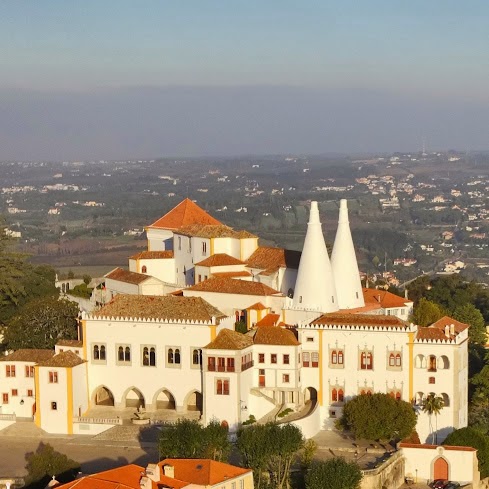
another time. And there will be one.From the outside, the Sintra National Palace may not look impressive, with plain white walls, and the ornate designs limited to windows and walls.
But as soon as I walked in, I was transported to another time. It has been preserved really well, perhaps because it has been inhabited throughout since the 15th century. Even today, the President of Portugal uses a private wing in the Palace when he wishes to entertain. The decors show off the moorish influence from the guilded and ornate cabinets, the arches, decorated doorways, bedposts... and ceilings!
 |
| picture courtesy of Palacio Nacional de Sintra |


Why is it that we no longer paint our ceilings these days? It seems to me that it would be a great focal point in a house. In the Palace, the room Sala dos Cisnes' ceiling featured 27 swans wearing inverted crowns on their necks in honor of the princess' (I forget which) 27th birthday and her 2 pet swans.
In another room, Salas das Pegas, the ceiling features 136 magpies, each holding a rose in their beak, with the words "Por Bem" meaning For Good/Honor. The story goes that the King Afonso Henriques was caught kissing a lady in waiting, and this king commissioned the painting with the 136 magpies representing the 136 gossippers. The rose is his wife, Philippa's insignia. In essence, he is asking the gossips to stop for the good of the queen.


The Galley room ceiling features... galleys! It features the three key players during the time of exploratoin: Holland, Turkey and Portugal, but you have to look closely at the ships' old flags to identify them.


 |
| Inside the chimney cone, looking up |
 |
My grandparents used to cook this way in Tiaong, with burners to heat the pots (see back wall)
Spits to cook cows, pigs, etc. (front)
|
The palace was really too big to visit in only a few hours, so we only saw parts. Still it was very educational especiallly for someone like me who is not too familiar with Europe's rich history, outside of what I learned in books.
 After we exited the palace, our guide suggested the best pastry in Sintra. Eh. I've had enough of being herded like a cattle, so I separated from the group for my free time. Besides, I've had way too many Portuguese pastels already, and all that history made me thirsty. And there I saw it, Bar do Binho, which just happen to have port tasting. So... you mean to say that I can do my wine tasting in Sintra instead of the vineyard? I chose wisely then. Before you get the wrong impression, let me say that I'm neither a sot nor a wino. I just happen to have a taste for port, and sherry, and other sweet liquors. They just make me happy.
  I told the bartender (is that what they're called too?) that I was operating on limited time and wanted to taste the really special ones. He pulled a 10 year old vintage white port from the back of the fridge and said that it was unique because only a few bottles were made of this vintage. And, I happily own this one now, along with a few other Portugal wines. I've never actually heard of Portuguese green wine before this trip, but they served it on multiple occasions at the conference, and I liked it.
On the way back to Lisbon, we rode mostly along the Atlantic ocean, and saw forts, mansions, fishermen boats, and a rainbow.
 |
| A rainbow over Tagus river; as if the day was not beautiful enough. |
 After a quick stop at the hotel to refresh and change, I took a cab to the banquest at Convento do Beato. This historic building was constructed in the 16th century. The story goes that with just 7 coins received from alms, friar Antonio got the monastery built, so they refered to him as Beato Antonio (Antonio the beatified). During dinner, we were treated to Fado music, which was even better than the one I listened to last night at A Severa, which was suggested by my hotel concierge. (Side note: tourist trap, mediocre food, high price; good Fado was the only saving grace for this restaurant.)
At past 11, still early for some, I bid my peers good night. I had to get up early and pack. It's time to go home.


